It’s 92° in Chula Vista. Your AC is running non-stop, but the house won’t drop below 80. At that point you’re not wondering if it’s uncomfortable — you’re wondering why your AC isn’t cooling, and whether it’s a quick fix or a full replacement.
This guide walks you through how to diagnose the problem: what you can safely check yourself in a few minutes, and what actually needs a technician. That way you don’t waste time, and you don’t waste money on a service call for something you could’ve fixed with a screwdriver.
At Airmaxx, we’ve been repairing AC systems across San Diego County since 1995, and most “not cooling” calls fall into a handful of predictable issues.
Why Is My AC Not Cooling? (Quick Answer)
Most AC systems that run but don’t cool have one of three issues: restricted airflow from a dirty filter or frozen coil, low refrigerant from a leak, or a failing electrical component like a capacitor. Start with the three quick checks below before calling a technician — many service calls get resolved by the homeowner before we ever need to dispatch.
Quick Self-Check: Three Things to Try Before Calling Anyone
Before assuming the worst, run through these three checks. They take five minutes and solve a meaningful share of the “not cooling” calls we get.
1. Check the thermostat. Make sure it’s set to “cool” (not “fan” or “heat”) and the temperature is set below the current room temp. Confirm the fan setting is on “auto,” not “on” — “on” runs the blower constantly even when the system isn’t cooling, which can feel like the AC isn’t working. Schedule overrides after travel are a surprisingly common culprit.
2. Check the air filter. Pull the filter out and hold it up to the light. If you can’t see through it, it’s restricting airflow and your system can’t cool properly. Replace it and give the system 30 minutes to recover. Regular AC maintenance catches this before it becomes a problem.
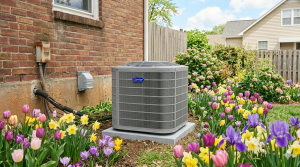
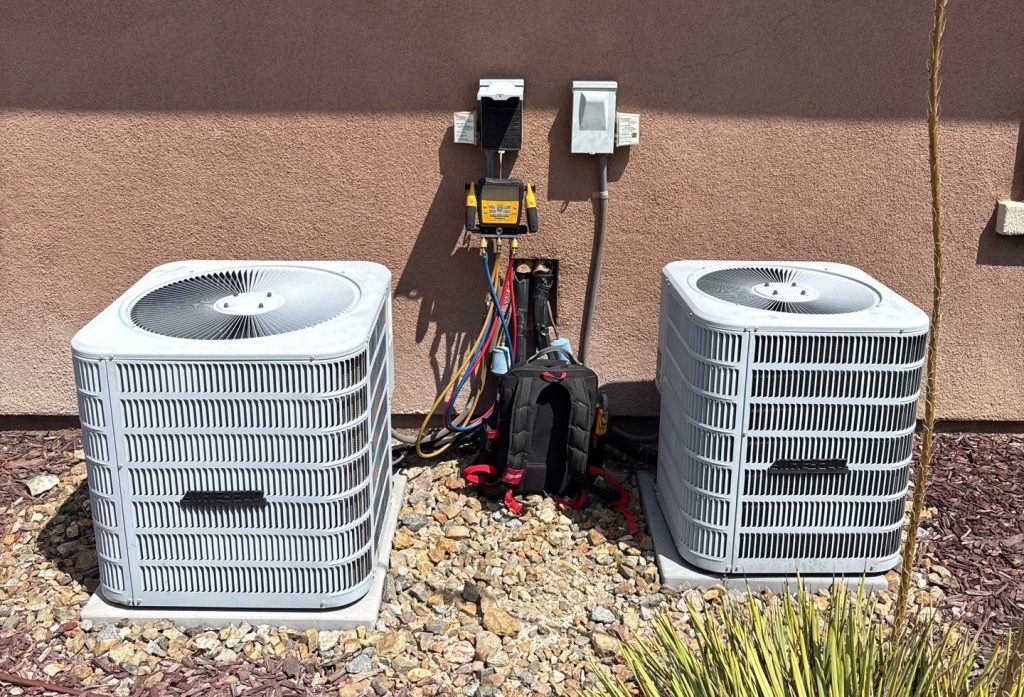
3. Look at the outdoor unit. Go outside and confirm the condenser is running. You should see the fan blades spinning, hear it working, and feel warm air blowing out the top. If it’s silent or the fan isn’t moving, jump down to Reason #5 (Failing Capacitor) or Reason #6 (Bad Contactor) — that’s likely your problem. If it’s running but covered in debris, see Reason #4 (Dirty Condenser Coil).
If those three checks didn’t solve it, keep reading.

The 8 Most Common Reasons Your AC Isn’t Cooling
1. Dirty Air Filter
A dirty filter restricts airflow across the evaporator coil. When airflow drops, the coil gets too cold and can freeze over. Once that happens, your system can’t absorb heat properly, so it stops cooling.
This is the easiest fix. Replace the filter and give the system time to recover. Filter checks are part of a standard tune-up and should happen at least twice a year in San Diego — more often if you have pets or live near construction.

2. Frozen Evaporator Coil
If your system has been running with poor airflow, the indoor coil may freeze. You might notice weak airflow, warm air, or even visible ice on the refrigerant lines coming out of the indoor unit.
The correct move: turn the system off and let it thaw — that takes anywhere from one to three hours. Running it while frozen or chipping at the ice can crack the coil and turn a $150 fix into a $1,500 one.
Can you fix this yourself? The thaw, yes. The root cause, usually no — frozen coils are almost always a symptom of dirty filter (#1), low refrigerant (#3), or a failing blower motor. A technician should inspect what caused it.
3. Low Refrigerant or a Leak
Refrigerant is what actually absorbs heat from your home. If levels are low, the system can’t cool effectively.
Important: refrigerant doesn’t get “used up.” If it’s low, there’s a leak. Any company suggesting they can “just add more” without finding the leak is cutting corners — you’ll be calling them again next summer.
This also matters for cost: as of January 2025, R-410A refrigerant is being phased out in new systems under the federal AIM Act and replaced with R-32 and R-454B. That’s pushed repair costs higher for older systems still running R-410A.
Can you fix this yourself? No — refrigerant work requires EPA certification and specialized equipment. Refrigerant leak repair is one of the more involved AC repairs; see our pricing guide for what to expect.
4. Dirty Condenser Coil (Outdoor Unit)
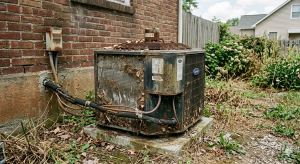
The outdoor coil releases heat from your home into the outside air. If it’s covered in dirt, dust, grass clippings, or coastal salt buildup, it can’t do its job — and the system overheats trying.
In coastal areas like Carlsbad, Encinitas, and Del Mar, salt air accelerates corrosion on the coil fins. Inland — Escondido, Poway, El Cajon — it’s dust and pollen that clogs them. Either way, the result is the same: lost efficiency, longer run times, weaker cooling.
A professional cleaning can restore performance, and annual maintenance prevents most coil issues from getting to this point.
5. Failing Capacitor
Capacitors give your system the jolt of energy it needs to start, then keep the motors running. In San Diego heat waves — especially inland — they’re one of the most common failure points. We see noticeably more capacitor calls during July and August than any other two-month stretch.
Symptoms include humming from the outdoor unit without the fan turning, hard starts, or the system trying to come on but failing. Sometimes the indoor blower runs fine while the outdoor unit sits silent.
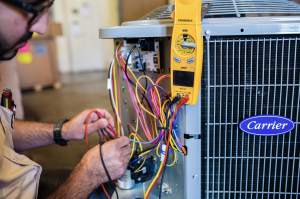
Can you fix this yourself? No — capacitors store an electrical charge even when the system is off and can deliver a serious shock. It’s a fast repair for a technician (usually under an hour) but not a DIY job.

6. Bad Contactor
The contactor is the switch that controls power to the outdoor unit. When it fails or gets stuck, the system may not turn on properly, may short cycle, or may run when it shouldn’t.
It’s often confused with a capacitor issue because the symptoms overlap, but the diagnosis is straightforward for an experienced technician. Contactors are an inexpensive part — what you’re really paying for is the diagnosis and labor.
7. Clogged Condensate Drain Line
Your AC removes humidity from the air, and that moisture drains out through a small line, usually a PVC pipe near the indoor unit. If the line clogs, most modern systems have a float switch that shuts the unit off as a safety measure to prevent water damage. On some systems, the thermostat may also lose power and go dark.
In coastal regions like Carlsbad, Encinitas, and Del Mar, higher humidity increases the chance of buildup in the line. Dirty filters also let debris pass through into the coil, where it eventually washes into the drain line and clogs it.
Can you fix this yourself? Sometimes — clearing the line with a wet/dry vacuum at the outdoor termination point works for minor clogs. Persistent clogs or recurring shutdowns mean the line needs to be properly cleared and the underlying cause (usually a dirty coil) addressed by a technician.
8. Undersized or Aging System
If your system is 12+ years old and struggling to keep up — especially during heat waves — it may not be a repair issue at all.
Older systems lose efficiency over time. Systems originally sized for mild coastal weather often can’t handle inland heat spikes after a homeowner adds square footage, finishes a garage, or builds an ADU. And once a system passes about 15 years, you start running into the cost of R-410A phase-out on top of normal aging issues.
This is usually the point where it makes sense to look at how long AC systems typically last in San Diego and evaluate replacement options.
Still Not Cooling? Here’s What to Do Next
If you’ve worked through the quick checks and the 8 reasons above and your AC still isn’t cooling, it’s time to bring in a technician. The longer you run a struggling system, the more likely you are to turn a small repair into a full replacement.
We’ve been diagnosing AC problems across San Diego County since 1995, and most of our service calls are resolved in a single visit. Schedule a diagnostic and we’ll tell you exactly what’s wrong, what it’ll cost to fix, and whether it’s worth fixing in the first place — no upsell, no pressure.
If your AC has needed multiple repairs over the past few summers, ask about our maintenance plan. Most of the issues on this list are preventable with twice-a-year tune-ups.
Written by David Glozman, a second-generation HVAC professional at AirMaxx Heating & Air Conditioning with eight years of hands-on industry experience and a B.S. in Management Science from UC San Diego
Frequently Asked Questions
HVAC can be confusing and technical. Below are the most frequently asked questions we get when scheduling AC repairs around San Diego County.
How long should I let my AC run before assuming it's broken?
On a hot San Diego day, a properly working AC should drop your indoor temperature about 1°F every 30 minutes. So if your thermostat reads 85° and you’ve set it to 75°, expect roughly five hours of run time on a 95° day. If it’s been running all day with no temperature change at all, that’s when you should start working through the diagnostic checks above — or call us.
Is it safe to run my AC if it's not cooling?
Short term, usually yes — but stop running it immediately if you see ice on the indoor unit or refrigerant lines, or if the outdoor unit is humming without the fan turning. Both situations can cause serious damage if you keep the system on. When in doubt, shut it off and call a technician.
How much does it cost to fix an AC that's not cooling in San Diego?
It depends entirely on the cause. A capacitor replacement runs a few hundred dollars. A refrigerant leak repair on an older R-410A system can run well into the thousands. We break down typical pricing by repair type in our AC Repair San Diego 2026 Price Guide.
Why is my AC running constantly but the house isn't getting cool?
This is almost always one of three things: airflow restriction (dirty filter or frozen coil), low refrigerant from a leak, or an undersized system that can’t keep up with the heat load. Most homeowners find their answer in the first four reasons in this guide.
Why does my AC work fine in the morning but stop cooling by afternoon?
This usually points to a system that’s marginal under high load. As outdoor temperatures rise, the system has to work harder to reject heat — and any underlying issue (low refrigerant, dirty condenser coil, weak capacitor, undersized equipment) shows up only when the system is stressed. It’s worth scheduling a diagnostic before the next heat wave, since these issues tend to get worse, not better.
My outdoor unit is running but no cold air is coming from the vents — what's wrong?
If the outdoor unit is running normally but the air from your vents isn’t cold, the issue is usually inside: a frozen evaporator coil, a clogged filter, a thermostat problem, or low refrigerant preventing proper heat exchange. Start with the filter, then check for ice on the indoor unit. If both look fine, you’ll need a technician to check refrigerant levels and the evaporator coil.